
MeerTech product · Energy and utilities

AditusOS: operating system for distributed energy.

An operating system for energy operators covering metering, mini-grids, distributed renewables and EV charging, built on a single ledger that tracks both kilowatt-hours and money.

Built Checked October 2026
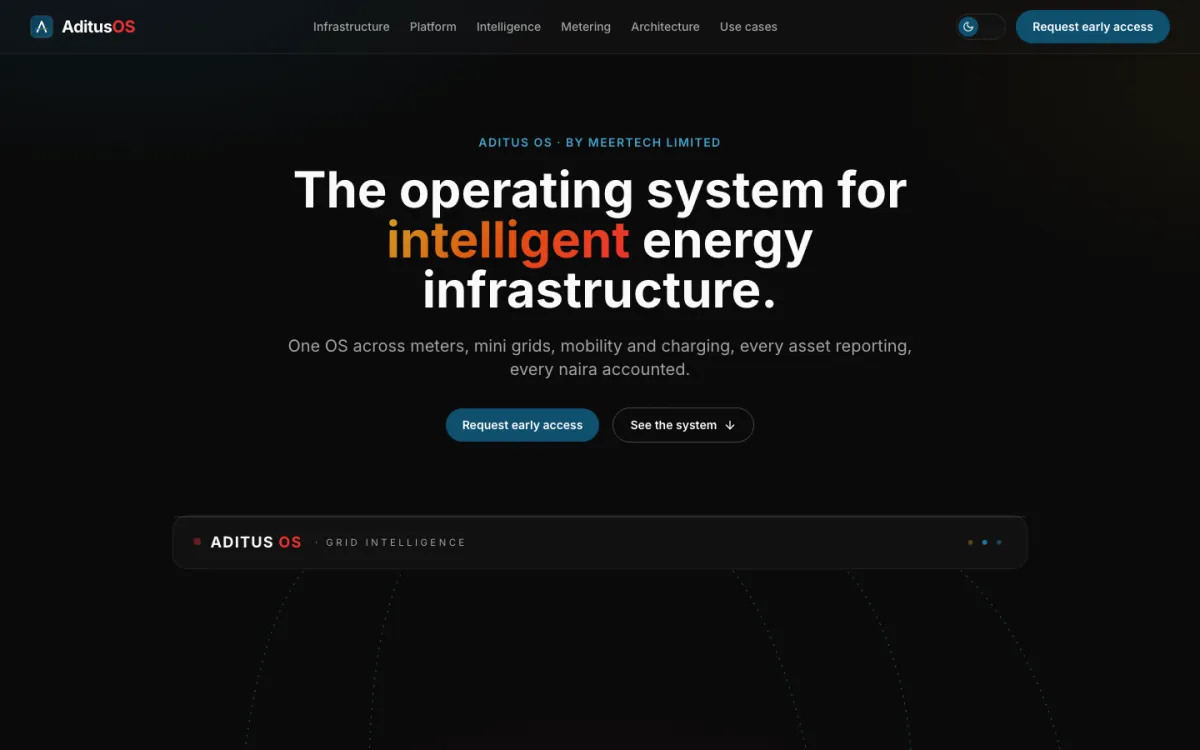
AditusOS home page with the headline The operating system for intelligent energy infrastructure
AditusOS · Web · API
01What it does

One operating system for metering, mini-grids and distributed energy.

Status
Built. Complete and tested, with no operator deployment yet.
Built for
Energy operators
Platforms
Web, API

Key capabilities

  1. 01One double-entry ledger for energy and money, with its rules enforced by the database
  2. 02A separate database schema per operator, with isolation checked by automated tests
  3. 03Vendor connectors that must pass a conformance suite before they reach production
  4. 04Prepaid sales and metering that orchestrate certified headends and never generate tokens
  5. 05Site pipeline from pre-construction through energisation and operation
  6. 06Live event feed in the operator console

BoundaryA component of AditusOS runs remote monitoring across 70 mini-grids. The full operating system is complete and tested, awaiting its first operator deployment.

02Problem and approach

The operational challenge

Energy and money, reconciled after the fact.

Distributed energy operators run metering, vending, site development and field work in separate tools that disagree with each other. The energy delivered and the money collected are reconciled after the fact, if they are reconciled at all.

Who uses it. Solar mini-grid developers and operators, and companies running metering, distributed renewables or EV charging.

The engineering approach

Model the site once. Ledger everything.

AditusOS models each site and its assets once, from the development pipeline through to operation, and records every kilowatt-hour and every naira in one double-entry ledger. Equipment and vending vendors connect through plug-in connectors that must pass a conformance suite, and simulators are blocked from production. Token generation stays with certified headends.

03Architecture

How it is put together.

  • Python 3.12
  • FastAPI
  • PostgreSQL 17
  • TimescaleDB
  • PostGIS
  • Next.js
  • Expo
  1. 01Core Python and FastAPI modular monolith
  2. 02Data PostgreSQL 17 with a schema per operator, TimescaleDB for telemetry and PostGIS for sites and assets
  3. 03Ledger Double-entry, with balance rules enforced by the database rather than by application code
  4. 04Integration Connectors to meters, headends and vendor APIs, each gated by a conformance suite
  5. 05Clients Operator console and an installable customer web app; a field app is built but not yet tested on handsets
Fig · AditusOS architectureSchematic. Components as built; no measured values.
04Operating conditions
  • Connectivity

    Sites report late or not at all. Stale data is shown as stale, with its age.

  • Missing inputs

    Without conductor and transformer data, loss figures are reported as unavailable rather than estimated.

  • Hardware

    MeerTech builds no hardware. AditusOS integrates with the meters and headends an operator already owns.

Where it stands

A component of AditusOS runs remote monitoring across 70 mini-grids. The full operating system is complete and tested, awaiting its first operator deployment. We are not going to call it a deployment until it is one. Early access requests are open at aditusos.com.

Contact

Talk to the team behind AditusOS.

Describe the infrastructure, the workflow that costs you most, and your connectivity as it really is. The first call is with an engineer.