MeerTech product · Trade and export · Agriculture

ExportFlow: export document compliance.

Checks Nigerian agricultural export documents against each other and against destination requirements, and grades every finding before a mismatch holds a shipment at the port.

Deployed Checked October 2026
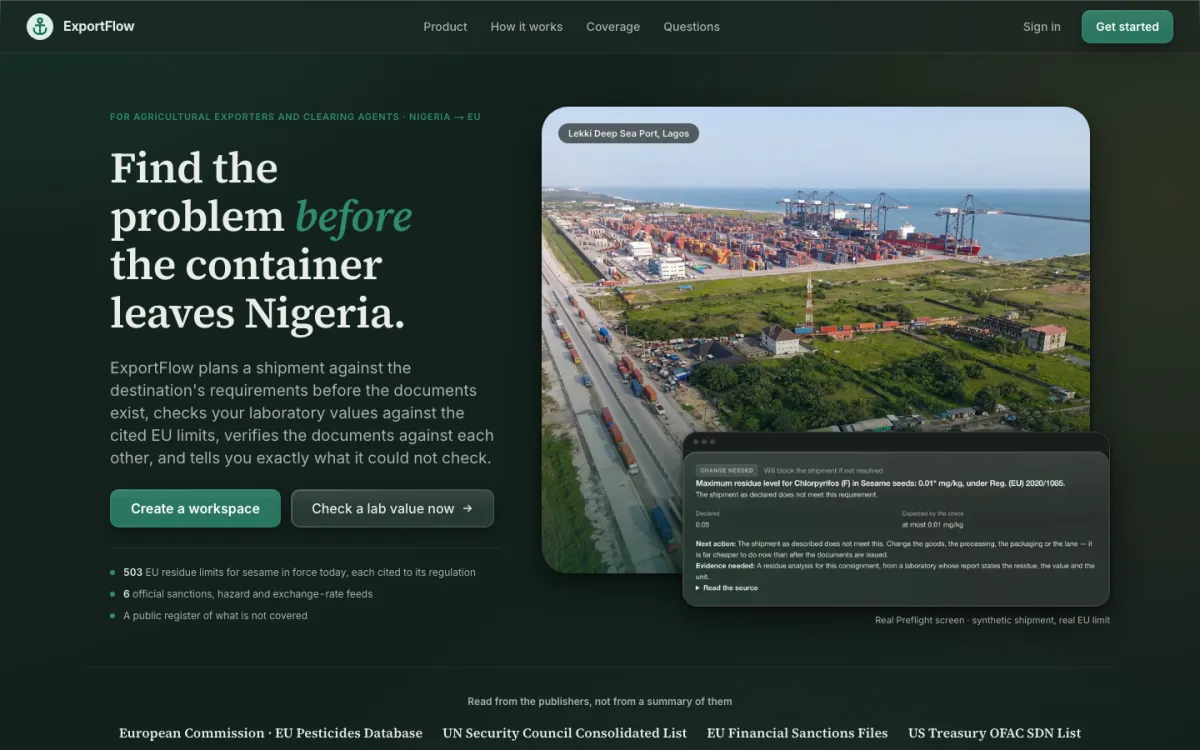
ExportFlow home page showing a document check report over a photograph of a container port
ExportFlow · Web · Android · API
01What it does

Export compliance checks before the container leaves.

Status
Deployed. A client, institution or the public is using it in production today.
Built for
Agricultural exporters and clearing agents
Platforms
Web, Android, API

Key capabilities

  1. 01Cross-checks the bill of lading, invoice, packing list, phytosanitary and origin certificates
  2. 02Grades findings Critical, Verify or Clean, with an explicit statement of what was covered
  3. 03Preflight planning against destination requirements before documents exist
  4. 04Lab values checked against cited EU limits
  5. 05Sanctions and hazard watch on shipments already moving
  6. 06Every field is either extracted or marked unavailable, never guessed
02Problem and approach

The operational challenge

One mismatched field can hold a container.

A single disagreement between an export's bill of lading, invoice and certificates can hold a container at the port or get it rejected at its destination. Exporters and clearing agents usually find these errors by hand, late, and under time pressure.

Who uses it. Nigerian agricultural commodity exporters and the clearing agents who prepare their documents.

The engineering approach

Read every document. Check them against each other.

ExportFlow reads the shipping documents, extracts their fields and checks that they agree with each other and with the destination's published requirements. Each finding is graded and tied to the rule that produced it. A preflight mode plans a shipment against those requirements before any document exists, and a risk view watches sanctions lists and hazards for shipments that are already moving.

03Architecture

How it is put together.

  • Python
  • FastAPI
  • PostgreSQL
  • Tesseract OCR
  • ClamAV
  • Next.js 15
  • React 19
  • Expo
  1. 01Document pipeline PDF parsing and OCR, virus scanning on upload, and extraction into typed fields marked Extracted or Unavailable
  2. 02Rules Versioned, published rule sets for cross-document and document-specific checks; every finding names the rule and version that produced it
  3. 03Data PostgreSQL with row-level security per organisation, plus S3-compatible object storage
  4. 04Clients Next.js web app and an Expo mobile app with an encrypted local queue
  5. 05Hosting Web app on Vercel; API on a dedicated server alongside its database and scanner
Fig · ExportFlow architectureSchematic. Components as built; no measured values.
04Operating conditions
  • Document quality

    Scans and phone photos vary in quality, so missing fields are reported as missing rather than inferred.

  • Changing rules

    Destination limits change. Rules are versioned, and every report says which version it used.

  • Timing

    Checks are most useful days before loading, which is why preflight works before the documents exist.

Where it stands

Live at exportflow.app with public sign-up, and published on Google Play for Android. ExportFlow reports what it checked and what it could not check. It does not certify that goods meet a specification.

Contact

Talk to the team behind ExportFlow.

Describe the infrastructure, the workflow that costs you most, and your connectivity as it really is. The first call is with an engineer.